If you’ve ever wondered how do I generate quality leads online for my business in India, you’re not alone. You’ve run Meta Ads for a month. You’ve posted consistently on Instagram. And the leads are still all over the place. One month you’re overwhelmed with inquiries; the next, nothing. That’s not a budget problem. That’s a pipeline problem.
Many small businesses in India rely heavily on a single channel or, worse, word-of-mouth alone. When that channel dips, revenue dips with it. With competition rising in every metro and tier-2 city, that’s a fragile position to be in. Businesses that consistently generate quality leads online aren’t lucky. They’re running coordinated, multi-channel strategies where each piece feeds the next.
This guide breaks down the specific channels, tactics, and structures you need to build a consistent online lead pipeline for the Indian market. Practical recommendations, real numbers, and no filler.
Why Most Indian Businesses Get Inconsistent Leads Online
The pattern shows up repeatedly: a business picks one channel, runs it hard for a few weeks, sees mixed results, and abandons it for something else. Meta Ads one month, SEO the next, then back to referrals. The problem isn’t the channels. It’s the approach. Quality leads, especially in B2B and high-ticket services, require multiple touchpoints before someone picks up the phone or fills out a form.
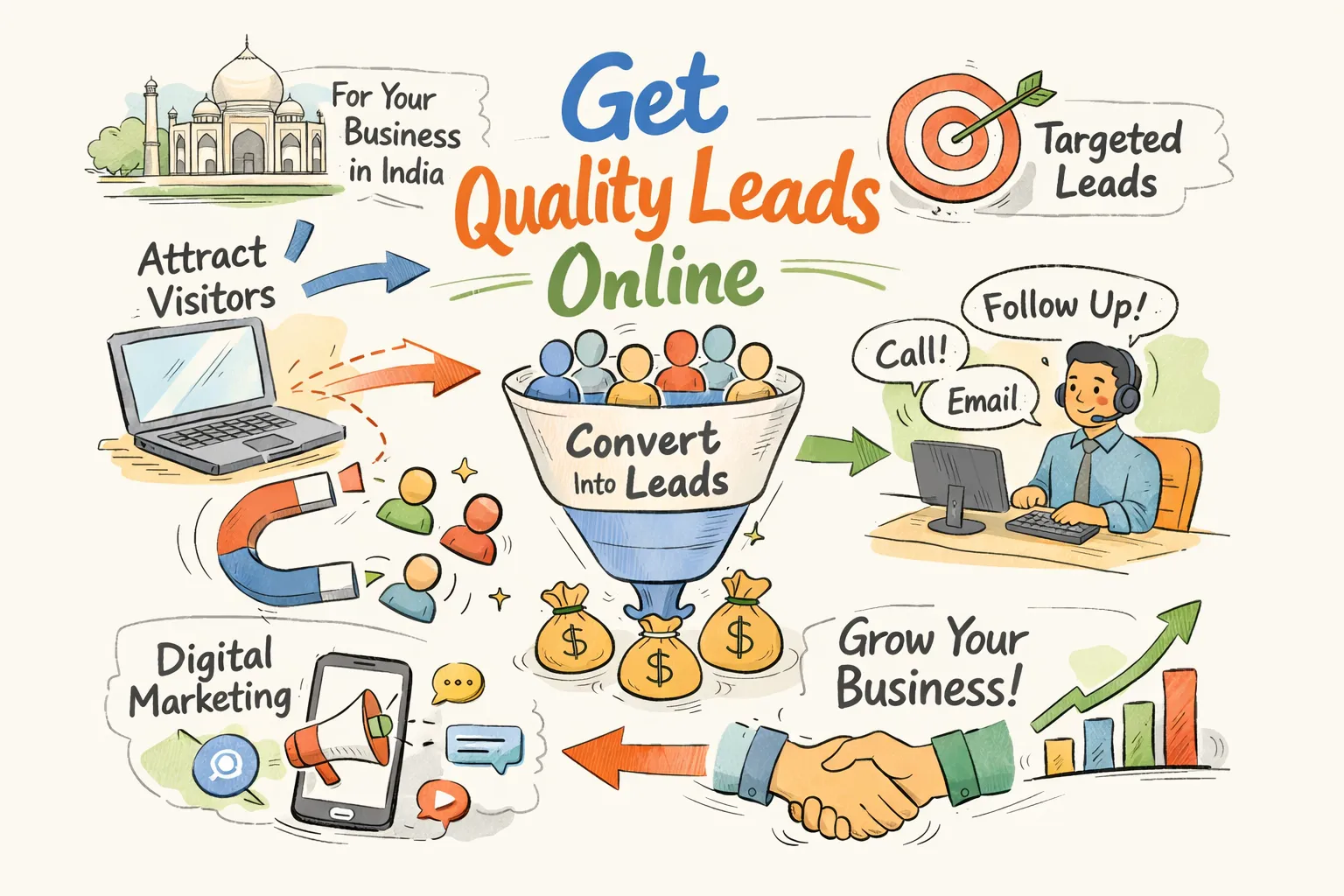
A healthy lead pipeline has four distinct stages: traffic sources (a mix of organic and paid), a conversion point such as a landing page or lead form, a nurturing mechanism like WhatsApp or email, and a qualification step that filters serious buyers from casual browsers. Many businesses skip several of these stages entirely. They drive traffic with ads but send it to their homepage. They collect phone numbers but follow up three days later. Every skipped step is a leak in the pipeline.
The fix isn’t finding one magic channel. It’s building a system where each stage connects to the next, and that’s the operating principle behind everything covered below.
How to Generate Quality Leads Online in India: SEO and Content Funnels
Indian buyers often use city- and price-specific long-tail queries, searches like “CA firm for startup registration in Bangalore” or “digital marketing agency in Pune.” These high-intent phrases are where organic SEO earns its keep. Targeting them through optimized service pages and blog content pulls in visitors who are already in buying mode, not just browsing.
Google Business Profile (GBP) optimization is one of the quickest wins for local businesses in metros and tier-2 cities. A fully optimized profile with accurate NAP (name, address, phone), updated photos, category-specific keywords, and regular review responses can meaningfully improve local visibility and help you appear in the local 3-pack, though timing varies by competition and signal strength. For a service business in Kolkata, Hyderabad, or Jaipur, that visibility often outperforms paid campaigns at a fraction of the cost.
A blog post that ranks is not a lead. It’s the start of a funnel. Structure your content across three stages: awareness content (how-to guides and explainers), consideration content (comparisons, case studies, and “best of” lists), and bottom-of-funnel content (pricing pages, service breakdowns, and ROI calculators). This is particularly important in B2B, where buyers in India research extensively across multiple sources before contacting any vendor. Trust is built through content before a conversation ever starts.
Set honest expectations on timeline. Organic SEO typically takes several months to show real traction, depending on your industry and competition level. Position it as the foundation that reduces your cost-per-lead over time, not as an immediate inquiry source. Businesses with the lowest CPLs at the 12-month mark are usually the ones who committed to SEO early.
Paid Ads That Generate Leads Faster: Google Ads and Meta Ads in India
Google Ads for High-Intent Lead Generation
Google Ads captures people who are actively searching for what you offer. Someone searching “chartered accountant in Hyderabad” is not browsing, they’re ready to contact someone. This intent advantage makes search campaigns the strongest paid channel for service businesses. Build tightly themed ad groups for each service, use lead form extensions to capture data directly in the search results, and invest real time in your negative keyword list. Wasted spend on irrelevant traffic is the most common mistake small businesses make with Google Ads in India.
Indian advertisers often see lower CPCs than global benchmarks on long-tail local terms, where competition is relatively thinner, though costs vary significantly by vertical and location. For a small to mid-size service business, a monthly Google Ads budget of around Rs. 15,000 to Rs. 40,000 can generate qualified leads when targeting and landing page setup are solid. Industry data suggests average CPCs in India can sit well below global averages, which means your cost-per-lead is largely determined by how well your landing page converts. For broader context on current B2B benchmarks, review this B2B cost-per-lead benchmarks.
Meta Ads Creative Tips for the Indian Market
Meta Ads work differently. You’re interrupting someone who wasn’t searching for you, so the offer has to earn their attention. Lead ad formats that load natively on mobile perform well in India, where mobile internet users represent the majority of online traffic. Use interest-based and lookalike audiences, test regional language creative where relevant, and understand that Meta leads typically need more nurturing than Google leads before they convert. Lower CPL on entry, more work on the back end.
Track your cost-per-lead from day one, not clicks or impressions. Clicks tell you what got attention. CPL tells you what’s generating revenue. Set up conversion tracking before you spend a single rupee on paid ads.
LinkedIn and B2B Outreach for Decision-Maker Leads
LinkedIn has a large and growing professional user base in India, concentrated in IT, finance, HR, operations, and consulting. Unlike Meta, the professional context means your outreach reaches people in a business mindset, not a social one. For IT firms, SaaS companies, consultancies, and agencies, LinkedIn is often the most direct path to the decision-makers who actually approve budgets.
Two plays work well on LinkedIn. The first is direct outreach: send a connection request with a brief, specific reason for connecting, then follow up with a message that leads with value rather than a pitch. Start by acknowledging something specific about their business. Your second message should earn attention with a genuinely useful insight or resource. Then ask for something low-commitment, a short call or a free audit. The second play is consistent content posting. Publishing thought leadership that addresses your target audience’s real problems attracts inbound connection requests and builds credibility over time.
Use both simultaneously. Outreach starts conversations faster. Content builds the authority that makes those conversations easier to convert.
Landing Pages and Lead Magnets That Convert Indian Visitors
Most businesses send paid traffic to their homepage and then wonder why conversion rates are low. A dedicated landing page built around one specific offer outperforms a homepage consistently. For the Indian market, three things matter above all else: fast mobile load time (the majority of your traffic arrives on mobile data connections), a headline that precisely matches what someone searched or clicked, and social proof in a local context. City-specific testimonials, recognizable client logos, and regional case studies build trust faster than generic claims.
The structure that works is straightforward: a clear headline, a supporting subheadline that expands on the benefit, one primary call-to-action, three to five benefit bullets, and a trust block with testimonials or client logos. Keep it focused. One page, one offer, one action. Every additional link or option you add reduces conversion. You can compare your page performance to industry averages in Unbounce’s conversion benchmark report.
Match your lead magnet to your sector. The most effective formats across Indian industries are:
- Retail and e-commerce: Discount coupons or first-purchase offers (price sensitivity is real and discount-led opt-ins convert consistently)
- B2B services: Free audits, ROI calculators, or specific process checklists (these work because they deliver immediate, tangible value)
- Education: Skill assessment quizzes or free sample lessons (addresses learning gaps in a competitive job market)
- Healthcare: Personalized health tools, symptom checkers, or free consultations (trust-building without commitment)
The lead magnet must solve a specific problem immediately. An offer that simply collects an email address without delivering real value will generate a list of people who don’t remember signing up and won’t respond to follow-up. For more inspiration, check this list of 10 lead magnets that work across industries.
Nurturing and Qualifying Leads So They Actually Convert
Capturing a lead is only half the job. What you do in the next few minutes determines whether that inquiry becomes a customer or goes cold. WhatsApp is where Indian buyers expect fast, personal follow-up. Research consistently shows that faster follow-up, minutes rather than hours, significantly improves conversion rates, and WhatsApp enables that speed better than email alone. Set up a WhatsApp Business sequence: an initial acknowledgment that confirms receipt, a value message with a relevant case study or tip, and a soft call-to-action that makes the next step easy. See a practical WhatsApp lead nurturing guide for sequence examples and messaging ideas.
One thing you cannot skip: TRAI DLT compliance. All promotional messaging via the WhatsApp Business API requires explicit opt-in consent from the user, typically via a clearly labeled checkbox or keyword confirmation. Message templates must be pre-approved and registered on the DLT platform. Businesses that skip this step risk fines and account restrictions. Work with a registered Business Solution Provider, MSG91 is one option, though several BSPs are available, to set this up correctly from the start.
Not every lead deserves the same follow-up effort. Build a simple qualification layer into your lead forms. Ask for budget range, timeline, or business type. A Google Ads lead who fills in all fields and mentions a specific budget is a different prospect from someone who clicks a social ad and submits a name and number. Score leads by source, form completeness, and response to your first outreach. Focus your sales time on the leads most likely to close, not just the most recent ones.
Lead Generation Strategies in India: Building the Full System
The real answer to how you generate quality leads online for your business in India isn’t a single tactic. It’s a coordinated system: SEO creates long-term inbound volume, paid ads fill the pipeline immediately, LinkedIn builds credibility with B2B decision-makers, landing pages convert that traffic into contacts, and WhatsApp plus email nurture those contacts into paying customers. Each channel is weaker alone. Together, they compound.
Start with one paid channel and one organic channel running simultaneously. Set up a focused landing page with a lead magnet matched to your sector. Add a WhatsApp follow-up sequence. Track your CPL from week one so you know what’s actually moving the needle. That’s a complete, functional lead generation system you can build incrementally without an enterprise budget.
For Indian businesses that want this built and managed end-to-end, Xink Digitals works with companies across industries to design exactly this kind of multi-channel lead pipeline, customized to their market, budget, and growth goals. Whether you work with an agency or build it in-house, the structure is the same. Pick one strategy from this guide and implement it this week. A working system with a modest budget beats a perfect plan that never launches.